Driving Sustainable Logistics: Our Commitment at the European Business Summit
Sustainability24 November 2025
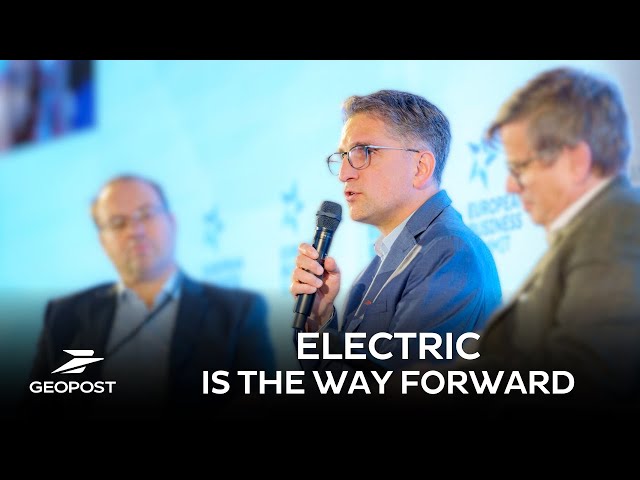
At the Brussels-based 2025 European Business Summit that brings policymakers and industry leaders together to debate the strategic choices necessary for Europe's enduring global strength, our Sustainability Director Dominique Mamcarz took part in a leading conversation to explore how logistics can accelerate the decarbonisation of European transport while enabling seamless cross-border commerce.
As the first global parcel delivery company with near- and long-term targets validated by the Science Based Targets initiative (SBTi), we at Geopost are committed to achieving net zero emissions by 2040 across our entire value chain (Scopes 1, 2, and 3).
Our progress is tangible. “We’ve already deployed more than 11,000 low-emission vehicles, and today 17% of our pick-up and delivery fleet is low-emission,” Dominique explains. “For linehaul trucks, nearly 17% of kilometres are powered by alternative fuels, including biofuels and electric trucks. These are important steps, but the journey ahead is even more ambitious.”
That journey is defined by clear milestones: by 2030, 85% of our light-duty fleet will be low-emission; by 2035, we aim for 100% low-emission solutions for first and last mile; and by 2040, all linehaul operations will rely on alternative solutions, with electric trucks at the core. “Electric is the future for heavy-duty transport, but the transition will require collaboration and investment,” he adds.
The challenges are significant. Scaling electric trucks depends on charging infrastructure and grid capacity, while heavy-duty vehicle electrification faces cost and availability faces hurdles related to affordability and availability of charging infrastructure. “Net zero cannot remain a wishful ambition, Dominique emphasises, it must be backed by practical solutions and strong partnerships where regulatory stability and public-private collaboration play an essential role in making this vision a reality.”
Dominique also highlighted the importance of policy consistency: “We support keeping the EU’s transport emissions targets as ambitious as possible. It is essential that the regulations already agreed upon be swiftly and effectively implemented, particularly the CO₂ standards and the Alternative Fuel Infrastructure Regulation (AFIR).
Regarding the Clean Corporate Fleet Initiative, we urge the European Commission to set purchase mandates at the national level only, and not at the company level. This approach ensures that enabling conditionssuch as infrastructure deployment, fiscal incentives for zero-emission vehicles and reportingare appropriately addressed.”
As we look to the future, our commitment is clear: to make sustainable delivery the standard across Europe and beyond. Achieving net zero by 2040 will require innovation, collaboration and shared responsibility. We invite policymakers, partners and industry peers to join us in shaping the future of logistics, because, through collaboration, we can turn ambition into action.
Watch the full discussion below.
Home / Driving Sustainable Logistics: Our Commitment at the European Business Summit