
Europe’s E-Shopping Shifts: Insights to Watch this Cyber Week
3 December 2025
Marking its 20th anniversary, Cyber Monday has become Cyber Week over the years and far more than a promotional period. It now signals deeper transformations in European online retail ౼ when shifting behaviours, rising expectations and the growing maturity of e-commerce stands starkly in plain view.
What started as a post-Black Friday push for online sales has evolved into a defining moment in the retail calendar, powered by limited-time deals and digital exclusives. Its global success reflects how firmly online purchasing has embedded itself into daily routines.
In fact, more Europeans are shopping online than ever: 77% according to the latest Geopost e‑shopper barometer ౼ up one point from the previous results published in 2023. Even more strikingly, regular e-shoppers* have grown faster still, reaching 52% compared with 48% in 2023. (*shoppers who purchase online at least once a month).
For the 2025 publication, Geopost cast a wide net ౼ surveying more than 30,700 people across 22 European countries. To help businesses understand the data and insights, Geopost developed an interactive e-shopper comparison tool to explore the evolving trends by country, revealing how expectations and habits differ across Europe ౼ insights that are especially valuable as the Cyber Monday peak approaches.
Discover just a few of the key findings below!
How is “Gen Z” shaping the future of e-shopping?
One of this year’s key takeaways is the pivotal role of Gen Z in shaping new e-commerce standards. More than any other demographic, Gen Z is driving social-commerce and consumer-to-consumer (C2C) behaviours across Europe.
Connectivity and community in e-shopping
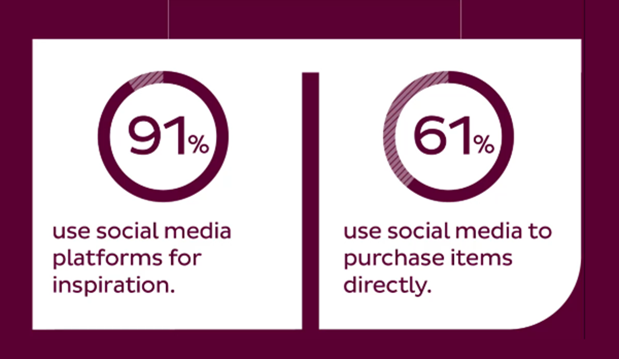
For starters, Gen Z is rewriting the e-shopping playbook through its use of social media. While social platforms remain central to the online shopping experience, the trend is even more pronounced among Gen Z. According to the e-shopper barometer, 91% of Gen Z shoppers use social media for shopping inspiration, compared with 70% of the general population.
“I find new brands through social media and influencers, and I always check the comments to judge reliability, quality and delivery”. - Ludmilla, Gen Z shopper on the importance of community in social media
The most popular platforms among Gen Z are TikTok and Instagram, both boasting an impressive 41% conversion rate, turning visitors into buyers. In addition, 61% of Gen Z shoppers purchase directly through social media, compared with 44% of the wider population.
The potential of feedback as user‑generated content
Another finding of note is Gen Z’s strong tendency to share feedback and post reviews, although this varies across regions. In Eastern European countries such as Romania (84%) and Bulgaria (82%), Gen Z shoppers are especially likely to publish comments, ratings, recommendations, or photos of their purchases.
By contrast, Western European countries such as Germany (60%) and The Netherlands (55%) have relatively lower engagement, with the European average standing at 70%.
For retailers, this insight highlights high user-generated content potential in some regions, and the need for more structured prompts in others.

Gen Z’s diverse payment habits
Across Europe, Gen Z’s preferred payment methods mirror those of the wider population, with credit cards (48%), digital wallets (47%), and debit cards (39%) topping the list.
In Eastern European countries, cash-on-delivery remains a common practice among Gen Z, particularly in Bulgaria (53%), Hungary (47%), Romania (44%), Slovakia (44%), and Slovenia (39%). However, usage is notably lower than among all regular e-shoppers, pointing to a generational shift in payment preferences.
As e-commerce markets in Eastern Europe expand rapidly, Gen Z e-shoppers are also adopting a wider range of payment methods, often more actively than their European peers. Credit card usage, for example, is especially high among Gen Z in Bulgaria (71%), the Czech Republic (67%), and Romania (65%).
Digital wallet adoption among Gen Z, on the other hand, is more strongly led by Western European countries such as Ireland (65%), Germany (62%), the UK (52%), and Italy (52%).
C2C spotlight: Second‑hand comes first for Gen Z
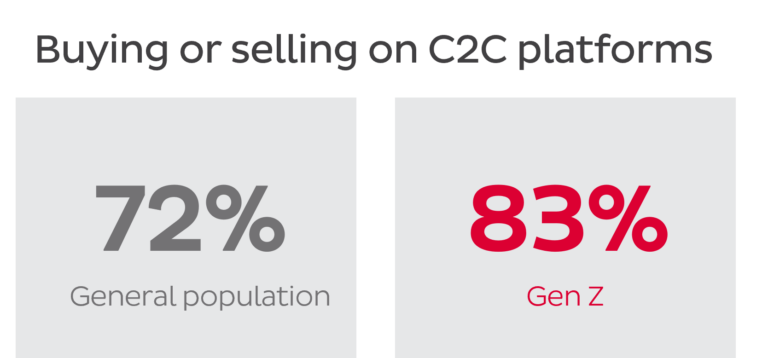
C2C commerce has become mainstream ౼ especially led by trend appeal among Gen Z, with 83% buying or selling on C2C platforms ౼ compared with 72% of the general European population. For many, secondhand shopping is second nature, driven by both financial and environmental motivations. In fact, 64% say C2C helps them save money, while 39% say it supports a more circular economy, a figure up five points from last year.
Digging deeper with our e-shopper comparison tool, we see that this trend leads across all regions ౼ a clear indication that the reuse mindset is a structural driver across Europe.
“The vast majority use social media for shopping inspiration. It’s their window shopping, where they learn what’s trending and what to buy. The impact is undeniably big." - Carmen Cureu, Market Research Director at Geopost
Cross-border shopping goes mainstream as consumers seek more choice
Cross-border e-commerce is gaining ground across Europe, led by smaller markets, where the local offer tends to be more limited. Slovenia tops the list with 72% of regular e-shoppers buying repeatedly from foreign websites, followed closely by Switzerland (70%) and Estonia (68%). Romania and Austria also stand above the European average of 46%, while larger markets such as France (45%), the UK (40%) and Germany (38%) remain below.
This trend reflects a structural reality: shoppers in smaller or mid-sized countries often turn to foreign websites because local manufacturers offer fewer options. As a result, cross-border shopping has shifted from an occasional trial to a regular habit, driven by the search for variety and competitive prices.

The rise of social media has further blurred borders, making international brands and offers feel closer than ever - especially in Europe, where exchanges are naturally more seamless. Retailers are seizing this opportunity to expand their reach:
“Across Europe, more online retailers and brands are expanding into more markets, and our results show cross‑border deliveries are now growing faster than domestic ones." - Hervé Crochet, Group Head of Sales at Geopost
Data‑driven insights for market‑specific strategies
For businesses, understanding the nuances that drive e-shoppers is key to building trustworthy, competitive, and market-relevant offers. With tools like Geopost’s e-shopper comparison tool, businesses can go beyond general trends to compare results by country and fine-tune their strategies based on real consumer expectations.