Heavy-duty electrification: Enabling Conditions Must Catch Up
18 March 2026
Summary: Geopost’s view is that heavy‑duty electrification in Europe is achievable, but it will not scale on ambition alone. The main barriers are commercial and operational: higher upfront costs, uncertain electricity pricing that complicates Total Cost of Ownership (TCO) modelling, limited grid capacity, slow permitting and an incomplete charging ecosystem for heavy‑duty use cases. Geopost’s experience scaling last‑mile electrification shows that utilisation, diversified charging models and a holistic energy strategy are now decisive as the transition extends from vans to trucks. To accelerate the shift, Geopost calls for predictable enabling conditions: faster permitting, transparent grid connection timelines, reliable charging availability beyond depots and stable, coherent policy signals that lower the TCO and investment confidence.

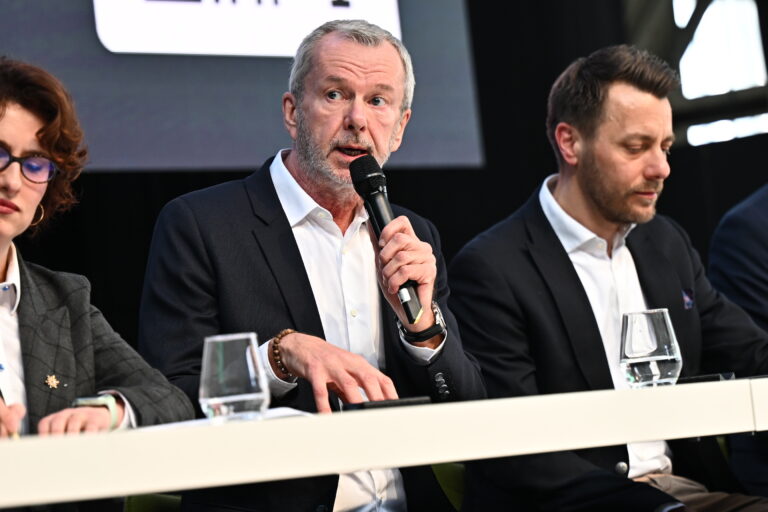
EVision is Eurelectric’s flagship e‑mobility conference, bringing together policymakers and industry leaders to examine Europe’s clean transport transition through high‑level panels, with a focus on fleet electrification. Geopost was represented at this year’s event by Jean‑Claude Sonet, EVP Marketing, Communication & Sustainability.
We've learned something important from scaling lastmile electrification: the transition is not a waiting game. Geopost has been an early mover in parcel delivery electrification, and we're now applying those lessons to the heavier end of the market. What will determine success at heavy-duty scale is not the level of ambition set on paper, but whether operators like us have the right conditions to make electrification operationally reliable and economically the go-to-choice and whether we're all willing to invest in making that happen.
Why heavy‑duty lags behind light‑duty
The electrification of heavy‑duty road transport in Europe continues to lag behind the light‑duty segment. This part of the market is fully commercial, with longer vehicle lifespans and higher upfront investments that have historically slowed adoption. Higher public charging costs, combined with uncertain long‑term electricity prices, make Total Cost of Ownership (TCO) calculations difficult. Grid constraints, slow permitting processes and the limited availability of national financial incentives remain significant barriers.
The debate often focuses on ambition, but fleet operators already know the targets. What's missing is clarity on the enablers: infrastructure timelines, grid access, energy price visibility and investment certainty. This is where Geopost's experience becomes relevant: not as a complaint but as a roadmap.
What we’ve learned from scaling last‑mile electrification
We are a global parcel delivery company present in 22 EU Member States, delivering over two billion parcels worldwide per year through our brands DPD, BRT, Chronopost, SEUR and Speedy. Our aim is to be the international reference in sustainable delivery. Our net zero target is 2040, and our near‑ and long‑term targets are approved by the SBTi, covering scopes 1, 2 and 3. In context, around 90% of our CO₂ emissions come from road transport and around 90% fall under scope 3, which means they sit largely outside our direct control.
Since 2020, our lastmile EV fleet has grown fivefold, a scale that has brought with it several practical lessons. These learnings now shape how we approach the next phase of electrification and how we support our transport partners in doing the same.
First, utilisation matters. Rather than electrifying only the shortest routes, Geopost is exploring how EVs can cover greater distances, because the more an EV is driven, the more cost effective it becomes.
Second, charging models must diversify. Depot charging has been essential but capital intensive, so Geopost is actively exploring ways to complement depot charging with offsite solutions, including partnerships with public charging networks and private operators. We've invested in over 8,000 depot chargers across Europe, but we're also funding charging infrastructure at our depots where drivers can charge their vehicles. We also offer, in some cases, grants to drivers so they can install chargers at their homes.
Third, the focus must broaden beyond vans. We are now approaching fleet electrification holistically, including truck electrification and the energy strategy required for an electric future. This means working closely with our transport partners to enable the transition. So, we’re not just setting targets and stepping back arms crossed.
These shifts have required real operational change and sustained investment. But they've also required us to act as an enabler. Through our Partner of Choice programme, we're leveraging our position as a market leader to help couriers access discounted rates with leasing companies for EVs. In many cases, we shoulder some of the additional costs couriers take on for electric vehicles through the rates we pay them, extended contracts and infrastructure investments. We are active members of coalitions such as the Climate Group's EV100 programme and the Smart Freight Centre.
Policy can improve TCO quickly, or slow it quietly
From a TCO perspective, we believe the full implementation of existing EU legislation is critical to accelerating the business case for low‑emission heavy‑duty vehicles.
Two instruments are particularly relevant. The Eurovignette framework, through CO₂‑differentiated road charging, can directly improve cost competitiveness. AFIR, through binding targets for high‑power charging along TEN‑T corridors (the EU’s Trans‑European Transport Network of main transport routes used for infrastructure planning), can reduce operational risk by providing predictable network coverage.
Without timely deployment, structural barriers will persist, especially for HDVs – the heavy-duty segment: limited site space, expensive and complex grid upgrades, uncertainty around energy availability, peak demand management and high upfront capex for fast charging.
At the same time, regulatory flexibility can deliver quick and measurable efficiency gains. National experience already shows that pragmatic approaches to weights and dimensions can improve asset utilisation and reduce emissions per parcel by enabling more load per trip and fewer vehicles on the road.
The real bottleneck: grid planning coordination
Grid planning coordination has become the decisive constraint. Early, structured engagement with DSOs (local distribution grid operators) and TSOs (high‑voltage transmission grid operators) is essential, as high‑power truck charging requires multi‑MW connections that compete with other electrification priorities. Without credible, aggregated demand signals and better alignment between transport and energy planning, grid constraints will delay corridor electrification and increase TCO risk.
What we're asking for
We’ve learned something straightforward from scaling electrification: fleets can adapt, but only when the fundamentals are reliable. For heavy‑duty, that means grid capacity, connection lead times, permitting and charging coverage. We are investing through infrastructure, partnerships and coalitions, but these are system constraints and we cannot solve them alone.
So, our ask is practical. Speed up permitting. Make grid access and connection timelines simple. Deliver AFIR corridor charging on schedule and apply road charging rules that genuinely improve the TCO case for zero‑emission vehicles. Pair this with targeted support where economics are still prohibitive, especially for SMEs. This is how Europe keeps ambition intact while making deployment possible in the real world, and how operators like Geopost can scale the transition beyond last‑mile delivery to the heavy‑duty segment.